
Table of contents
There are certain questions that come up over and over again in training. Are sleep regressions real? How do you combine responsive breastfeeding and optimal sleep? How do you get back on track after illness? And how you can support a baby with reflux to sleep better?
Reflux is something I suspect every parent has heard of, googled, or researched at some point. In some cases, people are quick to slap a diagnosis on an infant who may be behaving normally, or have a problem that could be resolved without reflux medication. For other families, reflux threatens the very enjoyment of parenthood, makes their baby miserable and can require near forensic investigation to get to the bottom of.
What is reflux?
Simply put, gastro-oesophageal reflux (GOR) is the regurgitation of stomach contents into the oesophagus, and sometimes out of the mouth and/or nose either during or after feeds. Reflux with or without vomiting can cause a burning sensation in the throat (like heartburn for adults), difficulty with feeding, distress, and growth problems/poor weight gain.
Infants with reflux may be fussy, dislike being placed flat on their backs, vomit several times per day, refuse feeds or have slow weight gain. It can be frustrating and distressing for parents to see their baby clearly upset and exhausting to try to comfort a baby who is often miserable after feeds.
Some babies have what’s known as ‘silent’ reflux: they regurgitate stomach contents but swallow them back down, so vomiting — the most obvious symptom — never appears. These babies can be just as uncomfortable, and because the tell-tale sign is missing, silent reflux is often harder to recognise.
Part of the reason for reflux (and wind/gas for that matter) is the anatomy of the stomach.
Take a look:
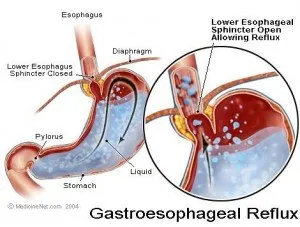
Obviously, this is a not-to-scale picture, but you can see that the stomach is not a round shape. Because air always rises to the top, you can see that one part of the stomach is actually higher than the oesophageal opening. If air gets trapped in this part of the stomach it can be hard to get out. Sometimes, babies vomit not because they have reflux, but because they have trapped wind. It’s easy to see that the solution is to have the baby held leaning on their left side, against your body.
Held like this, the highest point of the stomach becomes the oesophageal opening — so trapped air escapes more easily. Infants held in this position against a parent usually feel much more comfortable, burp more easily and cry less.
What is the prevalence?
It is estimated that more than 40% of babies have normal physiological reflux. 90% of these babies will outgrow it by the age of 1 year, but a much smaller proportion of babies have gastro-oesophageal reflux disease (GORD), which is a more serious presentation. You can read more about it here.
Is it reflux or something else?
Before rushing to a diagnosis of reflux, either GOR or GORD, parents who are worried about their baby should have them checked to rule out other problems that can mimic reflux, such as:
- Pyloric stenosis – a tightening in the pyloric sphincter of the stomach, which causes forceful regurgitation, dehydration, malabsorption and is a surgical emergency.
- Overfeeding – sometimes, especially is a baby is being bottle-fed, over-feeding is the underlying cause of discomfort and vomiting. A thorough feeding assessment and some simple improvements in feeding technique can make everyone a lot happier!
- Cows’ milk protein allergy – vomiting is actually a pretty sensible physiological response to a non-tolerated substance! If an infant has vomiting, stool changes, poor weight gain, skin problems or respiratory problems then have them checked by a doctor.
- Gastroenteritis – some viral or bacterial stomach upsets present with violent vomiting, as well as diarrhoea. If the problem is sudden in onset, then it may have an infectious cause. These babies need to be kept hydrated with small frequent breastfeeds, or rehydration solution. They may need medical attention if there are concerns about dehydration.
There are many other conditions that may be confused with reflux – which is part of the danger of surfing the internet typing in a baby’s symptoms! The best course of action is to receive individualized assessment and care from both feeding experts such as an IBCLC, and the child’s usual medical doctor to rule out other serious conditions.
What about medication?
Infants with simple GOR rarely need medicating. Usually, simple strategies such as keeping upright after feeds, effective burping, loosening the waistband and nappy/diaper, and if bottle feeding, reviewing the feeding technique and volumes ingested are all strategies that make infants much more comfortable and reduce symptoms.
When infants have GORD which is causing poor weight gain, pain or feed refusal, they may be offered medications. It is still worth considering all the other simple strategies first however.
According to the latest guidelines, the first medication likely to be offered a baby with GORD is Gaviscon. Gaviscon is a mixture of sodium alginate and potassium bicarbonate. It works by forming a layer on top of the stomach contents, which makes the baby less likely to regurgitate. Usually the baby is prescribed sachets of Gaviscon, which need to be mixed with either cooled boiled water or expressed breastmilk after their feed, or the sachet can be added to a bottle of formula if the baby is formula fed. There is some useful practical information about giving infant Gaviscon here.
If the alginate (Gaviscon) therapy does not help within 1-2 weeks, then if symptoms are severe enough, the baby may be prescribed an acid-suppressant medicine such as omeprazole. (You may see ranitidine mentioned in older articles — it was withdrawn worldwide in 2020 and is no longer prescribed.) These drugs reduce the amount of stomach acid produced.
This means that if the infant regurgitates, the stomach contents will not burn the oesophagus as much, and the infant is more likely to feed well again. Note that these drugs do not actually stop reflux – they work to reduce some of the more severe symptoms of reflux – such as oesophagitis, a painful condition where the continuous acid reflux causes burning to the oesophagus. Obviously, if a baby is in marked distress and is experiencing symptoms of feed refusal, then this is a good reason to treat the baby with one of these drugs.
However, as with so many drugs, there are side effects, namely that drugs which reduce acid production may reduce nutrient absorption, and have been linked with an increase in allergies further down the line.
The best course of action is to reduce the symptoms of reflux as much as possible without medications, by trying to work out the root cause, before pursuing various medications.
Why does reflux cause sleep problems?
Position: Essentially, reflux can make babies uncomfortable. Uncomfortable people do not sleep well – full stop. More than that, going back to stomach anatomy, lying flat on the back is not particularly ergonomic for a baby with reflux. Leaning slightly forward and on the left side is ideal in terms of digestion and passive burping. However, of course, this totally contradicts safe sleep. There is almost never a scenario where the risks of reflux outweigh the potential risk of SIDS, so sleeping on the front, or even the side is discouraged.
Feeding: Babies with reflux often want to feed more frequently, and usually this is a sensible strategy to recommend. Particularly bottle-fed babies tend to be fed fairly infrequently – for example every 3-4 hours. Feeding the baby more frequently but with smaller volumes may make the baby more comfortable at night. This can seem counter-intuitive – surely if you feed more frequently you’ll have more sleep disruption?? Well, not necessarily. If a baby is uncomfortable from having a large feed, you may need to spend longer settling them after a feed. They may be harder to burp, and they may need holding upright for longer. By the time you factor all that in, you may be better off feeding more frequently, but having a baby who is more settled after feeds.
Constant feeding: Sometimes babies get into a vicious cycle of feeding to soothe the acid burning sensation, but then the feed causes further reflux. If there is a break in between then this may just be one of those things that needs to be accepted as a temporary measure in infancy. However, if babies are either feeding, or crying because of reflux, and not actually sleeping well at all, then this is a problem. If babies are only sleeping because they are being held bolt upright against a napping parent’s chest, then this is a problem. Each individual baby needs to be addressed on a case-by-case basis, as every baby is different. But occasionally, increasing the length of time between feeds may actually help the baby to be more comfortable.
Why will my baby with reflux only sleep on my chest?
This is one of the most common things parents of refluxy babies say — and it makes complete physiological sense. Upright against your chest, gravity keeps stomach contents down, your baby is gently inclined rather than flat, and the warmth, containment and sound of your heartbeat are powerfully regulating. Your baby isn’t being ‘manipulative’ or forming a ‘bad habit’ — they are choosing the position in which they are most comfortable.
The difficulty is that an adult chest is not a safe sleep surface if you fall asleep too. If your baby will only sleep on you: keep yourself safely awake during chest naps, or take shifts with a partner; hold your baby fully upright for 20–30 minutes after feeds before attempting a transfer; and always place them on their back on a firm, flat surface for unsupervised sleep. Inclined sleepers, wedges and side-sleeping are not safe alternatives, however much they appear to ease reflux. As comfort improves — through feeding adjustments, effective winding, treating an underlying allergy, or simple maturation — most babies gradually accept the cot again.
There is also a second layer to this, quite separate from the reflux. Babies are wired for proximity, and closeness to a warm, responsive adult is one of the main ways a baby regulates at all. Your warmth, your breathing, your smell and your movement are signals that help an immature nervous system settle. So a refluxy baby on your chest is getting two things at once: the physical relief of being upright, and the regulation of being held. That is a powerful combination, and it explains why the cot can feel like such a poor substitute.
It also explains the transfer problem. When you lift a sleeping baby onto a mattress, the warmth, pressure, movement and heartbeat all disappear at once. That sensory change alone is enough to startle a young baby awake — before reflux is even a factor.
Dr Lyndsey Hookway on why babies only sleep when held — and what to do about it.
None of this means you have created a bad habit. It usually just means you found something that worked. And sleep development rarely follows a straight line — you may get a day of beautiful cot naps followed by a day where it falls apart entirely. That is normal, not a sign you have gone backwards.
Nor does it have to be all or nothing. Plenty of families keep contact naps for most of the day and work towards one cot nap so they can eat, shower, work or spend time with an older child. Some babies do better with that flexibility; others prefer more consistency. There is no universal rule here.
Wondering whether what your child eats is part of the picture? See how food and eating relate to sleep, or read more on whether contact naps are a problem at all.
Target the treatment to address the cause
Ultimately, the best way to address sleep problems caused by reflux is to find out the underlying cause of the reflux and deal with that. The best thing a sleep coach can to is to provide simple strategies that are likely to help, whilst also referring to appropriately qualified professionals for further advice and assessment. If it’s a cows’ milk allergy in disguise, then eliminating cows’ milk, either with an elimination diet in a breastfeeding mum, or an extensively hydrolysed formula for a formula fed baby will help. If it’s overfeeding, then reducing feed volumes will help. If the feeds are large and infrequent, then smaller more frequent feeds will help. If the baby is not being effectively winded then teaching correct winding technique will help. You get the idea….
But in addition, some other strategies that may help get babies more comfortable and sleeping better include:
- Holding upright for at least 30 minutes after feeds
- Effective winding
- Small, frequent feeds
- Prioritising breastfeeding – breastmilk is digested faster, has less allergenic load, and tends to be naturally lower in volume
Finally, supporting parents is a key part of the management of a baby with reflux. Supporting an infant who is crying a lot, has difficulty with weight gain, or vomits profusely is demoralizing, depressing and exhausting. It can be especially frustrating for a parent to spend time and take care to feed their baby responsively and slowly, support them in physiologically helpful positions, only for them to vomit copious amounts of the milk they have spent effort getting down them. I quite understand parents’ irritation, desperation for a diagnosis and ‘cure’ and frustration.
Yet, we know that being calm is contagious. While there may be little we can do about reflux until we either enlist professional help, wait for medication or diet to take effect, or the infant to simply mature, we can do a lot to help parents feel more confident. Parental confidence is a gift that lasts a lifetime. Support parents by listening, validating their concerns, signposting to the right people, recommending some simple strategies, and providing an empathic shoulder – that’s half the battle.
The last part is working on practical solutions: Recommend strategies to stay calm, present, grounded and confident. Recommend easy sensible solutions to help babies feel more comfortable. Support parents to identify their sources of respite and support, and continue to be there for them while they get to the bottom of their baby’s reflux.
That’s how to support a baby with reflux – no gimmicks, no snake oil. Just compassion, knowledge and practical solutions.
Reflux and baby sleep: quick answers
Does my baby have reflux, or is this normal?
More than 40% of babies have normal physiological reflux. Vomiting alone — even frequent vomiting — does not mean a baby has reflux disease: if your baby is generally happy and gaining weight well, regular possetting is usually just part of infancy. Symptoms typically start before 2 months of age and resolve on their own by around 1 year.
What are the signs of GORD (reflux disease)?
Under the NICE guidelines, GORD is usually considered when a baby has obvious regurgitation plus one or more of: excessive crying, crying during feeds or back-arching during or after feeds; a hoarse voice or chronic cough; feeding difficulties, feed refusal or choking; faltering growth; or, in children over one, heartburn. Diagnosis should always come from a medical professional — not from symptom-searching online.
What is silent reflux in babies?
Silent reflux is when a baby regurgitates stomach contents but swallows them back down rather than vomiting. The discomfort is the same, but without visible vomiting it can be harder to spot — look for crying during or after feeds, back-arching, a hoarse cry and feed refusal.
When should I see a doctor about my baby’s reflux?
Seek a medical assessment if your baby has forceful or projectile vomiting, poor weight gain or faltering growth, feed refusal, blood in vomit or stools, breathing difficulties, or symptoms that begin suddenly. Other conditions — from cows’ milk allergy to pyloric stenosis — can mimic reflux, so proper assessment matters before any diagnosis or medication.
Will my baby grow out of reflux?
Almost always, yes. Around 90% of babies with physiological reflux outgrow it by their first birthday as the digestive system matures, they spend more time upright, and solids are introduced.
Ready to take the next step?
Three free ways to explore the Holistic Sleep Coaching Program — no cost, no obligation.
All free · No obligation